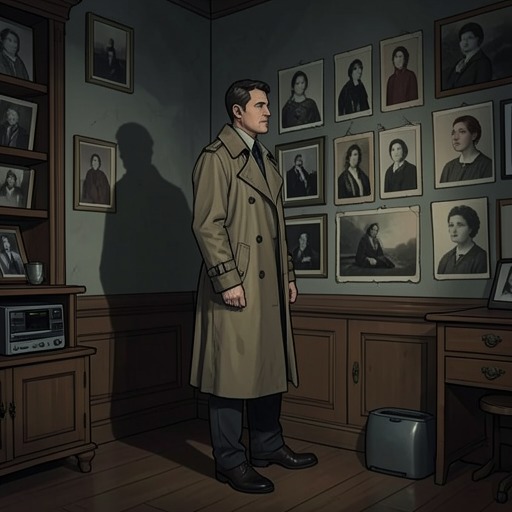
Lula’s voicemail to Guy Somé
The Cuckoo's CallingLula’s voicemail to Guy Somé is a brief recording with consequences larger than its length: it captures Lula sounding excited shortly before her death, and becomes evidence Somé offers against the conclusion that she had been suicidal. Yet it does not disclose the news she wanted to share. Its emotional force rests on that gap between the certainty in Lula’s voice and the answer Somé never sought.
The call and its circumstances
Lula phoned Somé on a Wednesday while he was still in Tokyo. He later explained that she often forgot the eight-hour time difference; his phone was muted at two in the morning, so he did not pick up. Lula left a message instead. Somé’s schedule was crowded with back-to-back meetings, and each time he thought of calling her back, the time difference seemed to intervene. The recording therefore preserves a contact that was attempted, received too late, and never completed as a conversation.
What the recording contains
When Somé plays the voicemail for Cormoran Strike, the narration presents Lula’s voice as immediate and vivid: close, slightly raw and throaty, and delivered in deliberately affected mockney. She greets Somé affectionately and says she has something to tell him, though she is unsure whether he will like it. She calls it a big piece of news, says she is so happy she has to tell someone, and asks him to ring when he can. The message ends with an affectionate sign-off. Its content establishes excitement and a desire to share something important, but supplies no explanation of what that news was.
Evidence in Somé’s account
Strike asks when Somé last heard from Lula, and Somé identifies the Wednesday call before playing the message. Strike then asks whether Somé called her back and found out what the big news was. Somé answers that he did not. These questions turn the voicemail from a remembered detail into a concrete investigative lead: the message records Lula’s state as she presented it to Somé, while the absence of a reply leaves its meaning incomplete.
Earlier in their conversation, Somé had argued that Lula would have contacted him if she were seriously thinking of killing herself. He says the two had made a pact to call one another in that situation. For him, the voicemail supports that confidence: Lula sounds happy, not suicidal, and she had reached out. It is evidence of what she said and how she sounded, rather than independent proof of her state of mind; its value in the investigation depends partly on the trust Somé places in their pact and his reading of her voice.
The unanswered news
Somé explains why he did not return the call: he was occupied with meetings, and he thought he already knew what Lula intended to tell him. He assumed she was pregnant and says he was not pleased by the possibility. That expectation shaped his inaction, but the recording itself never confirms it. The distinction is decisive: Somé’s inference is not the news Lula actually disclosed, because she did not disclose it on the message and he never called her back.
The voicemail thus preserves both contact and separation. Lula’s exuberance survives as sound, while the news behind it remains withheld. In the investigation, the recording challenges a simple account of Lula’s final days as uniformly despairing; as an object in the narrative, it also makes a missed opportunity audible. Somé can replay her voice for Strike, but neither replay nor retrospective interpretation can recover the conversation that never took place.